The 1% Panic: Why DTC Founders Misdiagnose Their Best Asset#
Almost every week inside our creative studio at CyberSolu, we get on a call with a jewelry founder who is quietly terrified.
They pull up their Shopify analytics, point to an overall store conversion rate hovering between 0.9% and 1.2%, and tell us: "Our website is leaking. We need a complete checkout redesign, or we need to start discounting."
When we ask why they think 1% is failing, the answer is always the same: they read an ecommerce case study or watched a guru claiming that "healthy DTC stores convert at 3.0% to 4.5%."
Here is the truth that generalist agencies will never tell you because they manage $30 pet toys on Tuesday and $50 sweatpants on Thursday:
Comparing the conversion rate of a $350 fine ring to a $40 apparel brand is financial suicide.
If you sell a $350 piece of fine or demi-fine jewelry and your store converts at 1.1% on cold paid traffic, your store is not broken. It is functioning exactly as high-consideration luxury commerce is designed to function. And if you attempt to "fix" that 1% using standard impulse-buy playbook hacks, you will destroy your brand equity and crater your contribution margin.
The $40 T-Shirt vs. The $350 Ring: The Math Nobody Shows You#
Let us look at two real-world brands competing for Meta and TikTok ad inventory in the exact same auction. Both send 1,000 cold visitors to their stores at a standard $1.50 Cost Per Click (CPC), spending $1,500 on ads.
| Metric | Brand A (Apparel / Impulse) | Brand B (CyberSolu Fine Jewelry Partner) |
|---|---|---|
| Product AOV | $40.00 | $350.00 |
| Traffic Sent | 1,000 Visitors | 1,000 Visitors |
| Total Ad Spend ($1.50 CPC) | $1,500.00 | $1,500.00 |
| Store Conversion Rate | 2.50% (Looks amazing) | 1.00% (Founder panics) |
| Orders Generated | 25 Orders | 10 Orders |
| Gross Revenue | $1,000.00 | $3,500.00 |
| Blended ROAS | 0.66x (Losing money) | 2.33x (Strong first-order scale) |
| Gross Margin (COGS) | 60% ($600 Gross Profit) | 72% ($2,520 Gross Profit) |
| Net Contribution Margin | -$900.00 | +$1,020.00 Profit After Ads |
Look closely at those numbers.
Brand A converted at 2.5x the rate of Brand B. Their vanity dashboard looks sensational. Yet Brand A lost $900 on cold acquisition because a $40 AOV does not provide enough gross profit dollars to cover modern Meta CPMs.
Brand B converted at "only" 1.0%. Yet Brand B generated $3,500 in revenue, a 2.33x first-order ROAS, and cleared over $1,000 in net profit after ad spend on cold traffic alone — before repeat purchases, referrals, and anniversary gifting kick in.
Conversion rate is a ratio. You cannot pay payroll or buy gold inventory with ratios. You pay with cash.
The 14-Day Latency Trap: Why Day-0 Shopify Analytics Lie#
The second reason jewelry founders misdiagnose their store is time-to-purchase latency.
When someone buys a $35 t-shirt or a tube of mascara, the decision latency is roughly 3 to 7 minutes. They see an ad on Instagram, click the link, pick a size, and tap Apple Pay before getting off the couch.
A $350 emerald-cut moissanite ring or an 18K solid gold chain does not work that way. When a prospective buyer lands on your site, they enter a multi-stage emotional and financial validation loop:
- 01Day 0 (First Touch): Shopper clicks a macro sparkle ad on TikTok or Instagram Reels. They love the aesthetic, bookmark the URL or take a screenshot, and browse 3 product pages. Shopify logs this as an unconverted session.
- 02Day 3 (Social Validation): Shopper sends the product link via WhatsApp or iMessage to their partner, sister, or best friend: "Look how gorgeous this setting is."
- 03Day 7 (Sizing & Practicality): Shopper wonders about their ring size or whether the chain length will layer with their existing jewelry. They check their nightstand drawer.
- 04Day 14 (Payday or Retargeting Touch): Shopper receives a personalized Klaviyo email featuring a customer review video or sees a CyberSolu water-resistance stress test ad on Meta.
- 05Day 18 (Conversion): Shopper returns via direct search or email and purchases for $350.

If you look at your Shopify analytics on Day 0, that visitor was counted as a failure. But across a 30-day cohort window, that visitor converted at 100%.
When mature jewelry brands calculate Cohort Conversion Rate (total orders from a visitor cohort within 60 days of their initial visit), that "broken" 1.0% conversion rate almost always expands to 2.2% - 3.4%.
The 3 Things Founders Do That Actually Break Conversion Rates#
When founders falsely believe their 1% conversion rate is broken, they almost always reach for the wrong playbook tools. Here are the three most dangerous moves:
1. The Panic Discount Popup
"Get 25% Off Right Now If You Order In The Next 10 Minutes!"
In fast fashion, countdown timers create artificial urgency. In fine jewelry, they trigger instant alarm bells. The shopper thinks: "If they can slash $90 off this ring in an annoying spin-the-wheel popup, is this real solid gold or gold-painted brass?" You kill trust to chase a vanity click.
2. Stripping Product Details to "Simplify Checkout"
Generalist UX designers love stripping down product pages to look like minimalist software landing pages. But fine jewelry buyers crave technical specifications: metal carat weight, hallmark engravings, band thickness in millimeters, gemstone origin, and prong setting security. When you omit these details to "keep the page short," you force serious buyers to abandon checkout.
3. Relying Solely on Sterile 3D CAD Renders
CAD renders look perfect on a 4K monitor in a design studio. On an iPhone screen, they look like plastic computer graphics. Shoppers cannot tell how large the gemstone sits on an actual knuckle or how the metal shines under natural golden hour light.
The Real Leaks: How to Safely Move CVR from 1.0% to 1.6%#
If your unit economics are already sound at 1.0%, moving your store to 1.5% or 1.8% represents pure profit scaling. Here are the 3 highest-leverage levers that actually move jewelry conversion rates without cheapening your brand:
1. Remove Sizing Anxiety Completely
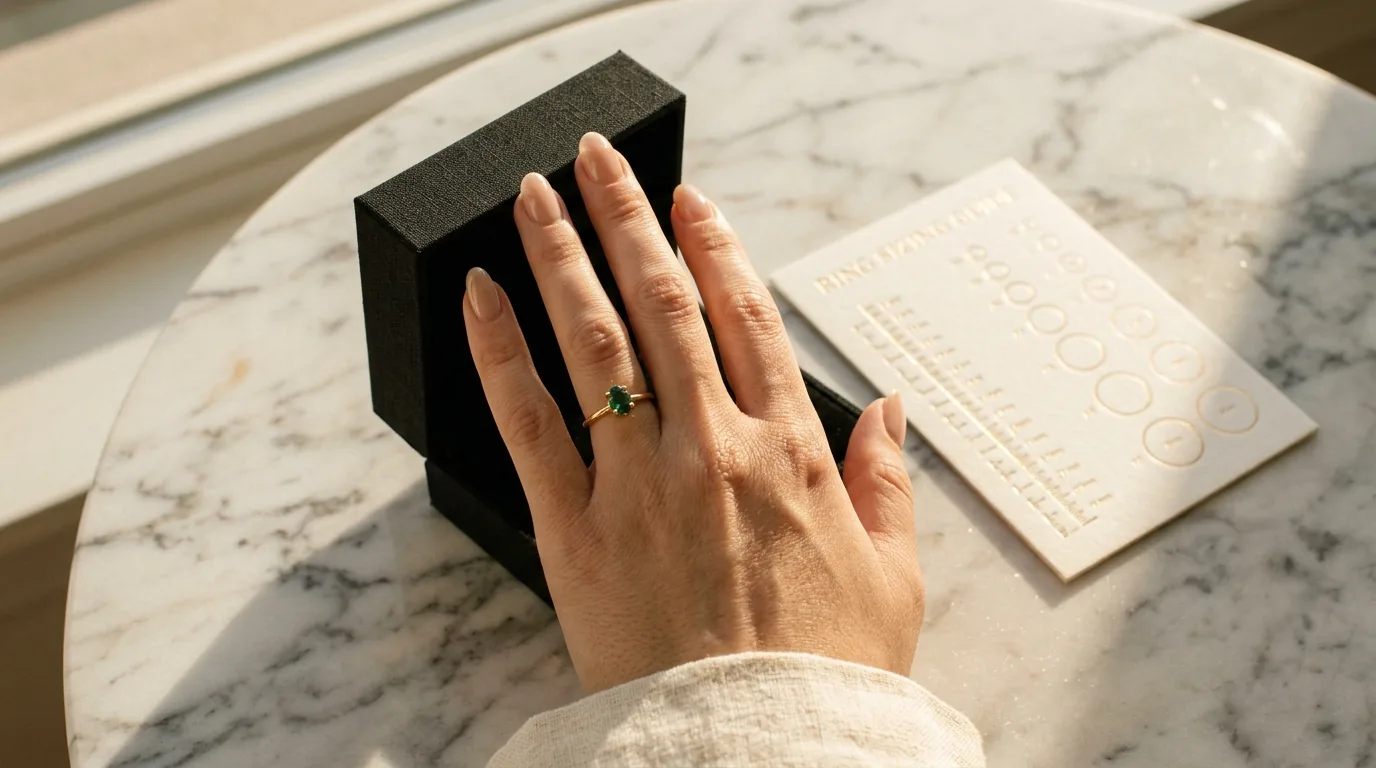
Ring sizing is the #1 silent killer of jewelry checkouts. Over 40% of abandoned ring carts happen because the customer is not 100% certain whether they are a size 6 or a 7.
- Solution: Offer a free printable ring sizer PDF on the product page.
- The Guarantee: Offer a free, zero-friction size exchange policy within 30 days. Display this directly below the "Add to Cart" button: "Wrong size? We exchange sizes 100% free with pre-paid return labels."
2. Showcase Authentic Macro Light Movement
Static photographs cannot capture fire, brilliance, and scintillation. Every product page for a hero SKU should feature a 5-second looping macro video filmed under direct 5600K light or natural midday sunlight. Show the piece turning, refracting light prisms, and resting against a real human hand.
3. Provide Ironclad Metal Durability Proof
Address the green skin objection directly on your product page and in your ad creatives. If your pieces are 18K gold vermeil, explain that your plating thickness is 2.5 microns (5x industry standard) over 925 sterling silver, backed by a waterproof and sweatproof guarantee.
The CyberSolu Growth Partner Takeaway#
Your conversion rate is not an isolated report card. It is one gear inside a unified brand machine that connects Average Order Value, Ad Creative Psychology, and Gross Margin.
Stop trying to force your $350 jewelry brand into a 3% fast-fashion mold. Protect your price points, honor your customer's 14-day consideration timeline, and feed your paid ad channels with creatives that prove craftsmanship.
If you want to see how we build high-converting jewelry creatives that command $250+ AOVs profitably, claim our 3 Free Custom Ad Concepts Challenge. Send us your hero SKU, and our creative team will engineer 3 bespoke angles and scripts before you ever take a sales call.